
Lecture 8
Paul Fiterau
Verification
Outline
- Background
- Transition systems
- Model checking
- Deductive Verification
Background
Testing asdynamic verification - Trying out the program on different inputs
- Actually running the program
Static verification - Analysed program is not run
- Reason on
mathematical model of our program (states) - There are also mixed approaches
- Automatic test generation from code structure
- E.g.,
symbolic execution generates a test case for each program path


What is correct ?
- Intuitively, a
mathematical proof has been found that given properties hold - All preconditions are respected
- All postconditions are always true
- Different from testing
All possible program inputs and scenarios considered- However: usually assume correctness of compiler, OS, HW, ...
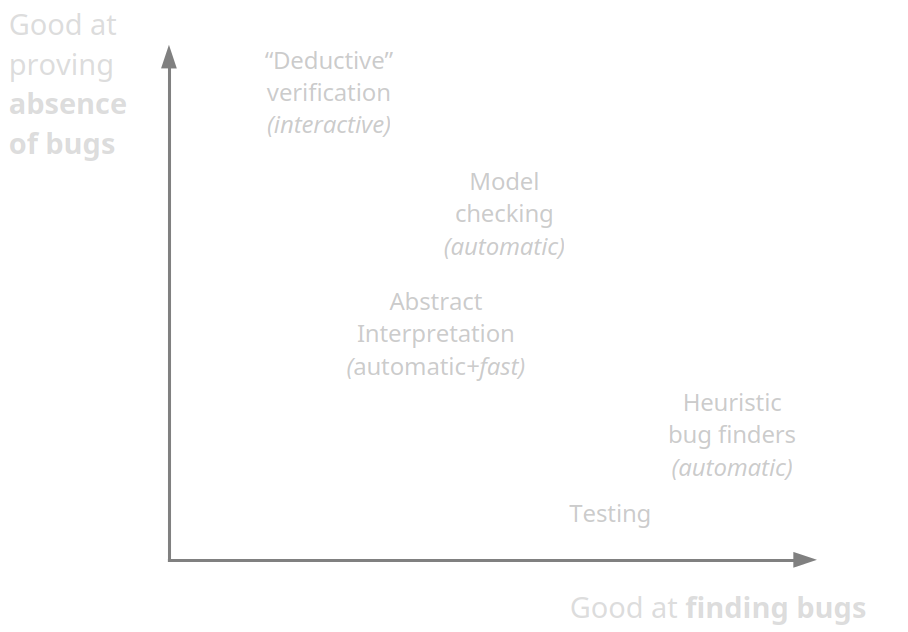
Verification vs Bug Finding
- Often tools/methods focus either on
- Systematically looking for bugs
- Verifying the absence of bugs
- First can usually not guarantee anything when no bugs are found
- Second usually fails when bugs are encountered
- Some tools/methods target both at the same time
Techniques
Deductive Verification
- Oldest approach to verification (going back to Turing)
- Requires
expertise + high effort - Usually need to annotate programs (invariants, ...)
- Common development philosophy (e.g., used in B-method)

- Success stories:
- seL4 L4 microkernel (~8000 LoC)
The cost of the proof is higher, in total about 20 py.
seL4: Formal Verification of an OS Kernel
Abstract interpretation
- Techniques based on fixed-point computation
- Good for "weaker" properties
- Absence of arithmetic overflows
- Absence of runtime exceptions
- Automatic, scalable, widely used by compilers (e.g., for optimizations)
- Success stories
- Astrée could verify primary flight control system of Airbus A340, A380
Model Checking
- Techniques based on (systematic) state-space exploration
- Many different flavours
- Success stories
- Hardware verification
- UPPAAL
Heuristic bug finders
- Usually based on a combination of mentioned methods
- Mainly focussing on
implicit specifications - Sometimes difficult to only report
genuine bugs
Example - Clang
			void f(void) {
			   int * x = malloc(10 * sizeof(int));
			}
			int main(void) {
			   f();
			   return 0;
			}
clang --analyze main.c
		main.c:5:11: warning: Value stored to 'x' during its initialization is never read [deadcode.DeadStores]
    5 |      int* x = malloc(10 * sizeof(int));
      |           ^   ~~~~~~~~~~~~~~~~~~~~~~~~
		main.c:6:3: warning: Potential leak of memory pointed to by 'x' [unix.Malloc]
    6 |   }
Transition systems
- A way of capturing the program states
- Mathematically a tuple $(S, I, \rightarrow)$
- State space $S$
- Initial states $I \subseteq S$
- Transitions $\rightarrow \subseteq S \times S$
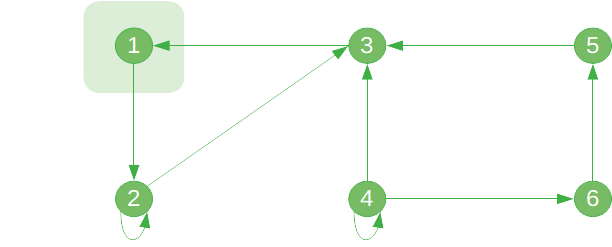
Program as transition system
- $S = \text{ControlLocations} \times \text{VariableValuations}$
- $I = \{\text{InitialControlState}\} \times \{\text{InitialValues}\}$
- $\rightarrow = ...$
Safety for transition system
- Identify set $\text{Err} \subseteq S$ of
error states - System $(S, I, \rightarrow)$ is
safe if there is no path $s_0 \rightarrow s_1 \rightarrow ... \rightarrow s_n$ with $s_0 \in I$ and $s_n \in \text{Err}$ - Safety of program =
unreachability in graph $(S, \rightarrow)$ - If no error state can be reached for any possible input, the program is safe
Example
		bool a, b;
		while(!a || !b) {
			if (a)
				b = true;
			a = !a;
		}
		assert(b);

Explicit-state model checking
- Explicitly construct graph $(S, I, \rightarrow)$
- Check reachability of error states
- Example tools:
Spin ,Java Path Finder - Problem:
state-space explosion - E.g., prog. with ten 32-bit integers has $\geq 2^{320}$ states
- Several solutions exist
- E.g., based on state space abstraction, or bounding the number of steps in state exploration
- Check videos of prior course offering (link on Studium)
Deductive Verification
Recap contracts
- Contracts define
pre - andpostconditions - For function contracts:
- Precondition must be upheld by the caller of the function
- Postcondition must be guaranteed by the function
- Contracts can also be put on individual statements
- If precondition holds before executing statement $s$, then the postcondition must hold after execution of $s$ has finished
- How can we apply this to C programs?
Background - Hoare Logic
- At each position (state) in a program we have a set of properties that are true
- With each statement that we execute these properties change
- Mathematical basis:
Hoare logic - An Axiomatic Basis for Computer Programming (Hoare, 1969)
- Describe a computation step as a
Hoare triple $\{P\}\; C \:\{Q\}$ - Whenever property $P$ holds, then after executing $C$ (if $C$ terminates), $Q$ will hold
- Example: $\{\Phi\}\; \textbf{nop} \:\{\Phi\}$
Background - Weakest Precondition Calculus
- Hoare logic gives us a formalism, but no algorithm
Weakest precondition calculus - Guarded commands, non-determinancy and formal derivation of programs (Dijkstra, 1975)
- Given the postcondition $Q$ and a computation $C$, we can mechanically derive a
weakest precondition $P'$ - If $P \Rightarrow P'$ then we have proven the contract
- Example: For $\{P\}\; x := a \:\{x = 42\}$ the weakest precondition is $\{a = 42\}$
Example
		/*
			PRE:  a > 0
			POST: ret > 0
		*/
		int f(int a) {

			int x = a;

			x = 2 * x;

			x = x + 2;

			return x;
		}
Example
		/*
			PRE:  a > 0
			POST: ret > 0
		*/
		int f(int a) {

			int x = a;

			x = 2 * x;

			x = x + 2;
			/* { x > 0 } */
			return x;
		}
Example
		/*
			PRE:  a > 0
			POST: ret > 0
		*/
		int f(int a) {

			int x = a;

			x = 2 * x;
			/* { x + 2 > 0 } */
			x = x + 2;
			/* { x > 0 } */
			return x;
		}
Example
		/*
			PRE:  a > 0
			POST: ret > 0
		*/
		int f(int a) {

			int x = a;

			x = 2 * x;
			/* { x > -2 } */
			x = x + 2;
			/* { x > 0 } */
			return x;
		}
Example
		/*
			PRE:  a > 0
			POST: ret > 0
		*/
		int f(int a) {

			int x = a;
			/* { 2 * x > -2 } */
			x = 2 * x;
			/* { x > -2 } */
			x = x + 2;
			/* { x > 0 } */
			return x;
		}
Example
		/*
			PRE:  a > 0
			POST: ret > 0
		*/
		int f(int a) {

			int x = a;
			/* { x > -1 } */
			x = 2 * x;
			/* { x > -2 } */
			x = x + 2;
			/* { x > 0 } */
			return x;
		}
Example
		/*
			PRE:  a > 0
			POST: ret > 0
		*/
		int f(int a) {
			/* { a > -1 } */
			int x = a;
			/* { x > -1 } */
			x = 2 * x;
			/* { x > -2 } */
			x = x + 2;
			/* { x > 0 } */
			return x;
		}
Example
		/*
			PRE:  a > 0
			POST: ret > 0
		*/
		int f(int a) {
			/* { a > -1 } => is implied by PRE */
			int x = a;
			/* { x > -1 } */
			x = 2 * x;
			/* { x > -2 } */
			x = x + 2;
			/* { x > 0 } */
			return x;
		}
WP calculus - revisit
- For a computation $C$ and a postcondition $Q$, WP calculus provides us with $wp$ s.t.:
$\{wp(C, Q)\}\; C\; \{Q\}$ is a valid Hoare triple
- $wp$ is computed mostly automatically
- This allows us to verify our function $fun$ by:
- Computing $wp(fun, Post)$
- Checking that $Pre \rightarrow wp(fun, Post)$
WP for different computations
- Assignment
- Sequence of statements
- Conditional execution
$wp(x := E, Q) = Q[x \leftarrow E]$
$wp(S_1;S_2, Q) = wp(S_1, wp(S_2, Q))$
$wp(if\; B\; then\; S_1\; else\; S_2, Q) = \\ (B \rightarrow wp(S_1, Q)) \wedge (\neg B \rightarrow wp(S_2, Q))
= \\(B \wedge wp(S_1, Q)) \vee (\neg B \wedge wp(S_2, Q))
$
Example
		/* { x >= 5 } */

		if (B)

			x = x - 2;
		else

			x = x - 4;

		x = x * 2;
		/* { x > 0 } */
Example
		/* { x >= 5 } */

		if (B)

			x = x - 2;
		else

			x = x - 4;
		/* { x * 2 > 0 } */
		x = x * 2;
		/* { x > 0 } */
Example
		/* { x >= 5 } */

		if (B)

			x = x - 2;
		else
			/* { (x - 4) * 2 > 0 /\ !B } */
			x = x - 4;
		/* { x * 2 > 0 } */
		x = x * 2;
		/* { x > 0 } */
Example
		/* { x >= 5 } */

		if (B)
			/* { (x - 2) * 2 > 0 /\ B } */
			x = x - 2;
		else
			/* { (x - 4) * 2 > 0 /\ !B } */
			x = x - 4;
		/* { x * 2 > 0 } */
		x = x * 2;
		/* { x > 0 } */
Example
		/* { x >= 5 } */
		/* { ((x - 2) * 2 > 0 /\ B) /\ ((x - 4) * 2 > 0 /\ !B)} */
		if (B)
			/* { (x - 2) * 2 > 0 /\ B } */
			x = x - 2;
		else
			/* { (x - 4) * 2 > 0 /\ !B } */
			x = x - 4;
		/* { x * 2 > 0 } */
		x = x * 2;
		/* { x > 0 } */
Example
		/* { x >= 5 } */
		/* { (x > 2 /\ B) /\ (x > 4 /\ !B) } */
		if (B)
			/* { (x - 2) * 2 > 0 /\ B } */
			x = x - 2;
		else
			/* { (x - 4) * 2 > 0 /\ !B } */
			x = x - 4;
		/* { x * 2 > 0 } */
		x = x * 2;
		/* { x > 0 } */
Example
		/* { x >= 5 } => { (x > 2 /\ B) /\ (x > 4 /\ !B) } */
		/* { (x > 2 /\ B) /\ (x > 4 /\ !B) } */
		if (B)
			/* { (x - 2) * 2 > 0 /\ B } */
			x = x - 2;
		else
			/* { (x - 4) * 2 > 0 /\ !B } */
			x = x - 4;
		/* { x * 2 > 0 } */
		x = x * 2;
		/* { x > 0 } */
Loops
- Loops are difficult
- We usually have to provide two things
Invariants - Properties that are true in every loop iteration
Variant - Something that changes with every loop iteration
- Needed for termination proof
- Loop variant needs to decrease monotonically
- More in Lab 4!
Frama-C
Fra mework form odulara nalysis ofC code- Collection of tools for working with C projects
- Each feature is a separate plugin
- Code browsing (metrics, callgraph, scope & dataflow analysis)
- Code transformation (sparecode removal, slicing, constant folding)
- Specification generation (RTE, Aorai)
- Verification (weakest precondition, abstract interpretation)
- Highly recommended reading after lab 4:
- A Lesson on Verification of IoT Software with Frama-C (Blanchard et al, HPCS 2019)